
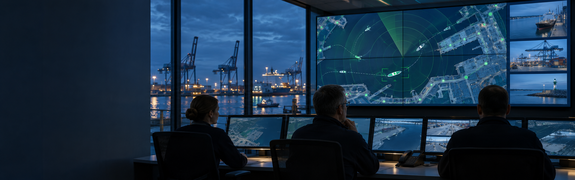
Most major ports already have extensive security technology in place: radar stations, cameras, AIS receivers, perimeter sensors and access controls. Each of these systems fulfils an important role. Yet one crucial question often remains unanswered: what happens if a threat can only be identified through the interplay of various pieces of information?
This is precisely where a key challenge for modern port security lies. It is not necessarily a lack of sensors, but rather insufficiently linked information that can create dangerous gaps.
Added to this is a source of information that has so far played only a minor role in many traditional security concepts: the electromagnetic spectru
One night, four systems – and nobody realises the connection
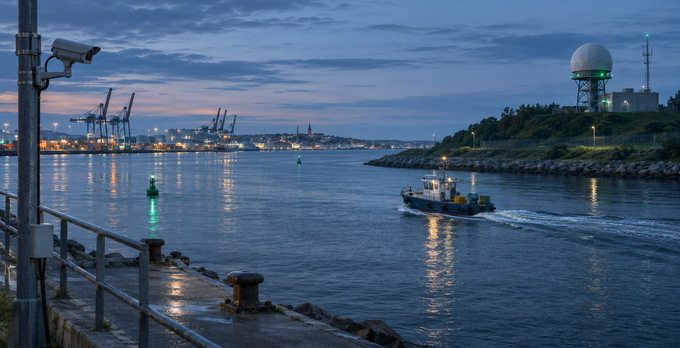
A fictional but realistic scenario:
At around two o’clock in the morning, a fishing vessel slows down as it approaches a harbour entrance. Its AIS signal appears unremarkable; the name and identification number match. The traffic control centre’s radar detects the vessel as one of many targets.
Shortly afterwards, a previously unknown radio signal becomes active for a few minutes. It goes unnoticed because there are no suitable sensors in that area to detect such signals.
Half an hour later, the fence sensors at a quay facility report a vibration. Such alerts occasionally occur in strong winds. The relevant camera shows nothing out of the ordinary – it is trained on the entrance to the site.
Each system has fulfilled its task. However, the individual observations were not linked together. Whether there is in fact a threat remains unclear.
This example illustrates a fundamental problem: individual security systems can function flawlessly from a technical point of view without this automatically resulting in a complete picture of the situation.
Why silos develop
The cause often lies in structures that have evolved over time. Port authorities operate traffic control centres equipped with radar and AIS. Terminal operators have their own camera, access control and security systems. Added to these are systems operated by private security providers, as well as information systems used by the police, customs and other authorities.
Each of these solutions was procured for a specific purpose. Over the years, this has resulted in powerful but, in some cases, isolated systems. The result: different data formats, multiple alarm interfaces and varying organisational responsibilities.
If alerts from these systems are not automatically consolidated, staff in the control centres must identify potential connections themselves. This is particularly challenging when workloads are high or situations are complex.
Furthermore, with every new threat, the temptation grows to introduce further standalone solutions: drone detection here, additional cameras there, underwater sensors elsewhere.
However, more technology does not necessarily mean greater security.
More sensors do not automatically mean greater safety
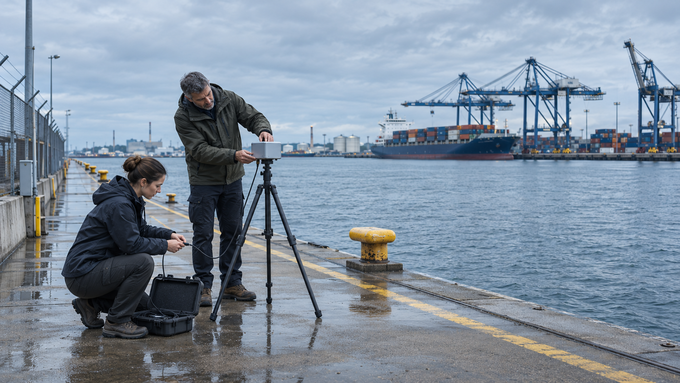
Every sensor generates information. Some of it is highly relevant, whilst other data relates to normal port operations.
A bird can trigger a motion detection alarm, strong winds can set off a perimeter fence alarm, and a radar can detect numerous unremarkable vessel movements.
If such alerts are forwarded to a control centre unfiltered, the workload increases. Relevant alerts can get lost in the flood of information.
The key task is therefore not to collect as much data as possible. Rather, the information must be processed in such a way that anomalies can be identified, verified and prioritised.
Modern security architectures are designed to support staff in assessing situations more quickly and making informed decisions.
In their joint white paper, ‘Maritime Resilience – Protecting Critical Infrastructure in the Maritime Domain’, PLATH and Eraneos describe an integrated approach to this end.
From individual signals to a coordinated response: four levels
The white paper presents a multi-layered security architecture that connects existing systems and consolidates their information into a shared situational picture.
The situation report consists of four levels
Level 1 – Sensors
Radar, AIS, cameras, satellite data, drone detection and underwater sensors capture various aspects of activity in and around the port.
Level 2 – Data fusion and verification
The information is linked together, checked for plausibility and examined for possible discrepancies.
Level 3 – Analysis and Situational Picture
The merged data is used to create a unified situational picture that highlights anomalies, assesses risks and supports the setting of priorities for further action.
Level 4 – Decision-making and Response
The insights gained are made available to the relevant authorities. They form the basis for coordinated measures involving port security, public authorities and, where necessary, other emergency services.
The key concept is that it is not individual systems, but their intelligent interconnection, that creates added value.
The aim is not to completely replace existing security architectures. Rather, existing infrastructures should continue to be utilised and supplemented where relevant capabilities are lacking.
An important addition: the electromagnetic spectrum
However, not every threat generates detectable radio activity. Autonomous systems or other communication methods may limit the capabilities of passive detection.
Radar and cameras detect objects and movements. AIS provides information about ships and their reported positions. However, not every security-relevant activity can be detected using this data alone.
This is where the electromagnetic spectrum offers an additional perspective.
Many unmanned systems use radio links for control or data transmission. Unusual communication activities, radar signals or interference with satellite-based navigation can also provide security-relevant indications.
Passive monitoring of the radio spectrum can therefore be a valuable addition to existing port security systems.
Subject to appropriate technical and legal conditions, it offers several possibilities:
- Early detection: Certain radio signals can be detected even before the associated activity becomes visible to optical sensors.
- Passive observation: Suitable receiving sensors detect transmissions without emitting any surveillance signals themselves.
- Classification and localisation: Depending on the type of signal and sensor configuration, transmissions can be classified, their direction determined and, where necessary, their source localised using multiple sensors.
However, not every threat generates detectable radio activity. Autonomous systems or other communication methods may limit the capabilities of passive detection.
The actual added value therefore only arises when information from
The situation assessment is based on interrelationships
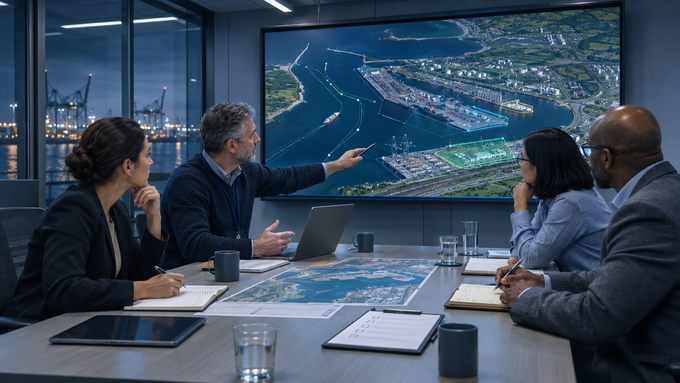
A number of typical application scenarios demonstrate just how valuable integrated information can be.
AIS and radar: If reported vessel positions differ from radar observations, this may indicate a discrepancy. It must then be investigated whether this is due to a technical fault, incomplete data or tampering.
Drone detection and cameras: If suspicious radio activity is detected and its direction determined, a corresponding integrated camera can be specifically aimed at the area in question. The additional visual information makes it easier to assess the situation.
GNSS interference and vessel movements: If a suitable system detects local interference with satellite navigation, unusual position data can be evaluated against this background. This helps to reduce misjudgements.
Vessel traffic and unknown signals: If unusual radio activity is cross-referenced with specific vessel movements in terms of time and location, additional clues may emerge that would remain undetected if considered in isolation.
None of these examples implies that a threat can be inferred from a single signal alone. Only the context enables a reliable assessment.
Knowledge of normal conditions is particularly important in this regard.
Every port has its own typical movement patterns, communication activities and operational procedures. Those familiar with these can better identify deviations and distinguish between
Make use of what is already in place rather than creating new parallel structures
A shared situational picture alone does not guarantee a faster response.
An integrated situational picture does not necessarily require a completely new security infrastructure.
Many ports already have suitable foundations in place: radar stations at exposed locations, traffic control centres, AIS receiving equipment, camera systems and established communication channels.
This infrastructure can serve as a data source, a location for supplementary sensors or a starting point for a shared situational awareness display.
New components should be deployed specifically where there is a relevant gap in coverage or where additional information provides demonstrable added value.
Modular, scalable and, where necessary, mobile sensors make it possible to expand existing capabilities as required. Open interfaces and interoperable system architectures facilitate the integration of different technologies.
The aim is not simply to add another screen in the control centre. The aim is to gain a better understanding of the overall situation. Technology and organisation must work together
A shared situational picture alone does not guarantee a faster response.
In many ports, operators, port authorities, security services, the police and other relevant bodies share different responsibilities. It must therefore be clarified what information may be exchanged, who assesses any anomalies and which body makes decisions in an emergency.
Technical interoperability and coordinated processes go hand in hand. Only when information reaches the relevant authorities in good time and can be translated into concrete measures there does an integrated security architecture realise its full potential.
Conclusion: Security arises from collaboration
The biggest security vulnerability is not necessarily a missing sensor.
It can arise where existing information is not linked together – across technologies, areas of operation and organisations.
A shared situational picture brings together different perspectives, supports the assessment of unusual activities and lays the foundation for coordinated responses.
Monitoring the electromagnetic spectrum can provide an important additional source of information in this regard. Together with radar, AIS, cameras and other sensors, it contributes to a more comprehensive situational awareness. In this way, existing security technology is transformed into an integrated security architecture that can better detect new threats and strengthen the capacity of port operators and security authorities to take action.
White paper: Maritime Resilience
How can existing security systems be integrated to provide a shared situational picture?
In the white paper *Maritime Resilience – Protecting Critical Infrastructure in the Maritime Domain*, PLATH and Eraneos explain the four-level model of an integrated port security architecture and use specific application scenarios to demonstrate how interconnected information can contribute to greater resilience.
Request the white paper now
Further articles in this series:
Part 1: When a fence is no longer enough – The new reality of port security
Part 3 (coming soon): From risk analysis to a resilient port – How port operators can gradually develop their security architecture
Follow us on LinkedIn to be the first to hear about new blog posts: www.linkedin.com/company/plath-systems-integration/
